Guides

Laura Nelson

TL;DR:
Brands keep running ads on out-of-stock products because attribution tools only look at channel performance, not inventory
Example: a viral dress racked up $261k+ in missed revenue while ads kept spending at full budget
Incrementality studies are backward-looking, they can't warn you when today's spend is wasted
What you should do: connect marketing velocity to real-time inventory so you stop burning budget on sold-out SKUs and redirect it to well-stocked products with demand
The Story First
A fashion e-commerce brand launches a new Signature Collection in mid-February. One item — The Lana Dress — goes viral almost immediately. The marketing team does exactly what you'd expect: they allocate roughly 16% of their Meta budget (over $312,000) to that collection over the following 30 days.

On paper, the channel is performing beautifully.
In reality, demand has outrun supply. The Lana Dress is now 83% out of stock, wiped out entirely in the sizes (S and XS) that drive the majority of conversions. Ads are still running at full spend. Customers are clicking through, hitting a sold-out page, and leaving. In four weeks, that single dress has generated an estimated $67,000 in missed revenue — and across the top 5 out-of-stock items in that collection, the loss exceeds $261,000.
Nobody connected the media buying decision to the inventory reality, and the spend kept running regardless. This happens more than most brands want to admit.
The Real Problem With How Brands Measure Ad Effectiveness Today
Incrementality studies have become the gold standard for justifying ad spend. Run a geo-lift test, measure the difference between exposed and holdout groups, calculate an iROAS. If the number looks good, keep spending.
That works up to a point.
The problem is what happens next. Incrementality studies produce a verdict on a channel in aggregate, based on historical data, typically over a 2-6 week test window. They were never built to tell you whether the dollars you're spending today are hitting products that customers can actually buy.
That gap is where revenue leaks. In practice, it looks like this:
A study confirms Meta is incremental ✅
$312,000 of Meta spend is pointed at a product that's 83% out of stock 🚨
The study sees nothing wrong, the spend keeps running, the leakage compounds
By the time the next test window closes, the damage is already done.
What Inventory-Aware Spend Optimization Actually Does
ProfitPeak connects media buying decisions to real-time inventory position. Measurement studies look backward. Inventory moves forward. Those two things need to be in the same room.
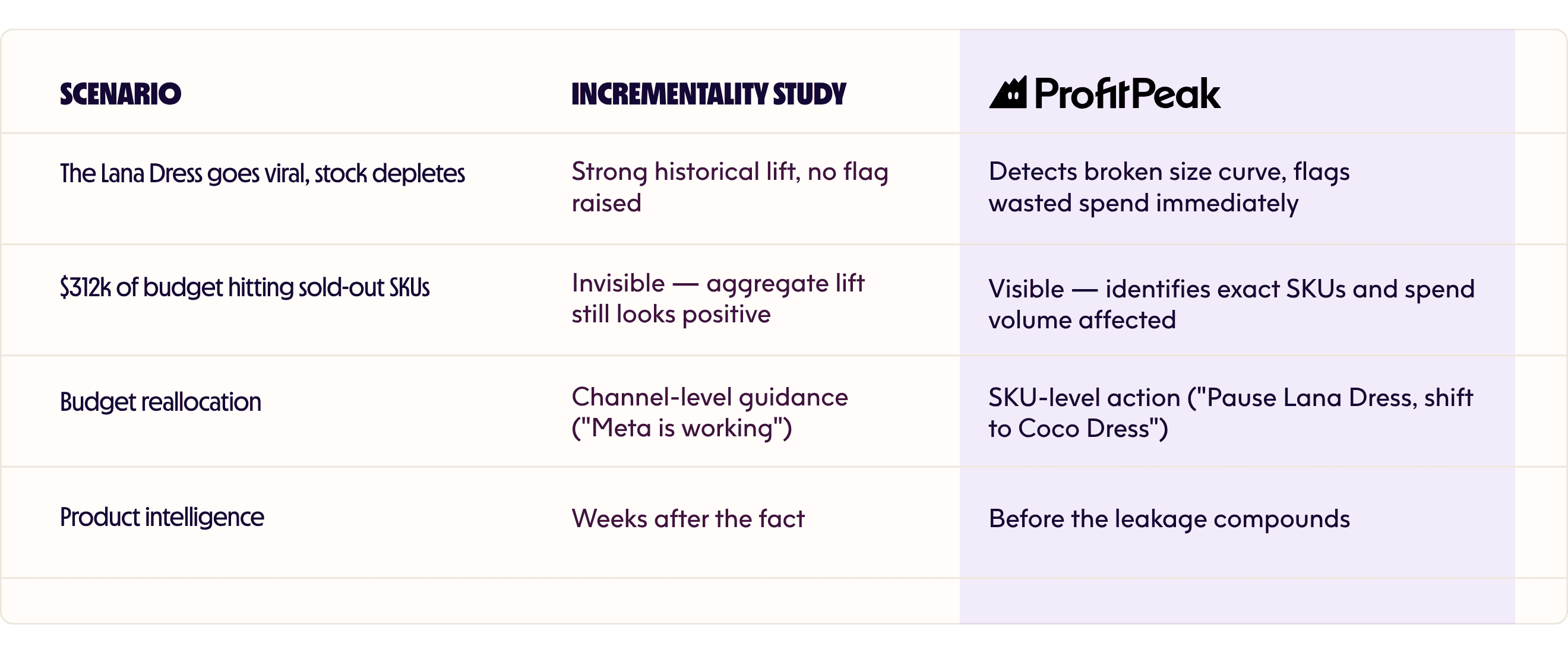
Here's what that looks like in practice:
Incrementality studies are a strategy tool. They tell you if a channel deserves budget. ProfitPeak tells you if that budget is pointed at something a customer can buy today.
The Three Problems ProfitPeak Solves
1. Wasted spend on broken inventory
When a product's size curve is broken (the most popular sizes are sold out while others sit untouched) ads pointing to that product are largely wasted. Customers click, can't buy their size, and leave. ProfitPeak identifies these broken curves in real time and flags them before they turn into a four-week, $261k missed revenue disaster.
2. The lagging signal problem
Any study built on historical lift data is telling you what was true weeks ago. In a high-velocity e-commerce environment, a product can go from hero to fully depleted in days. By the time a study confirms your spend is working, your best-selling sizes may already be gone. ProfitPeak uses inventory as a leading signal, so you get a warning before efficiency drops rather than a post-mortem after it already has.
3. Hidden budget sitting on the sidelines
The flip side of the Lana Dress problem is the hidden opportunity: products with strong organic demand, healthy stock levels, and no paid spend behind them. ProfitPeak surfaces these so when you pull budget off a broken SKU, you already know where to move it.
The Bottom Line
Incrementality studies confirm the channel works. ProfitPeak confirms the spend is going somewhere productive. Right now, for this brand, those two things are not the same.
One dress. Four weeks. $261,000 in missed revenue. Pull your own Hidden Gems list and see exactly where that recovered budget should go by booking a custom demo with our sales team today.
Laura Nelson
Founding Sales Director (North America)
Laura brings a wealth of experience with over 5 years of E-commerce SaaS sales to the business, having worked in pivotal roles for Prescient AI and Klaviyo. She is ProfitPeak's first US hire and will be based in California to build our stateside growth.