Features

Carla Penn-Kahn
Most DTC brands are sleeping on a real competitive advantage. There's a metric hiding in your product data that changes everything about how you scale. Here's how to read it.
You pull your product-level ad spend report. The numbers look fine. But something feels off — this product is converting well, yet the spend story doesn't quite make sense. Sound familiar?
Most marketing measurement tools give you campaign and creative level insights. It's useful, but it hides a critical distinction that changes how you should think about scaling.
THE THREE NUMBERS YOU SHOULD ACTUALLY BE LOOKING AT
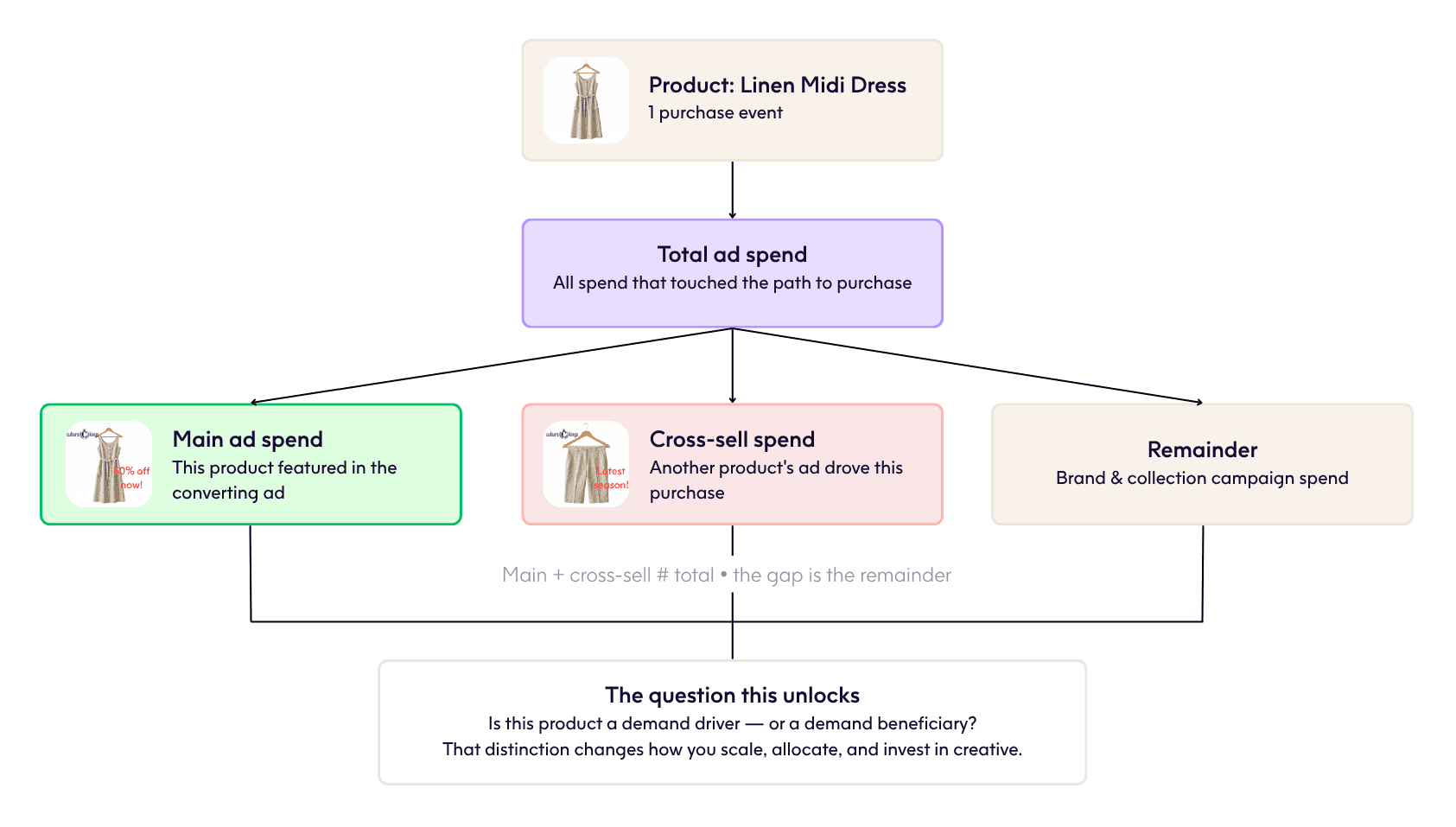
When ProfitPeak breaks down ad spend at the product level, we distinguish between three different things:
Total ad spend
All spend that contributed to the journey that ended with this product being purchased — regardless of which product featured in the ad. This is your familiar attribution model. It includes everything that touched the path to purchase.
Main ad spend
Spend where this product was the direct, featured conversion driver. The ad was for this product, and this product converted.
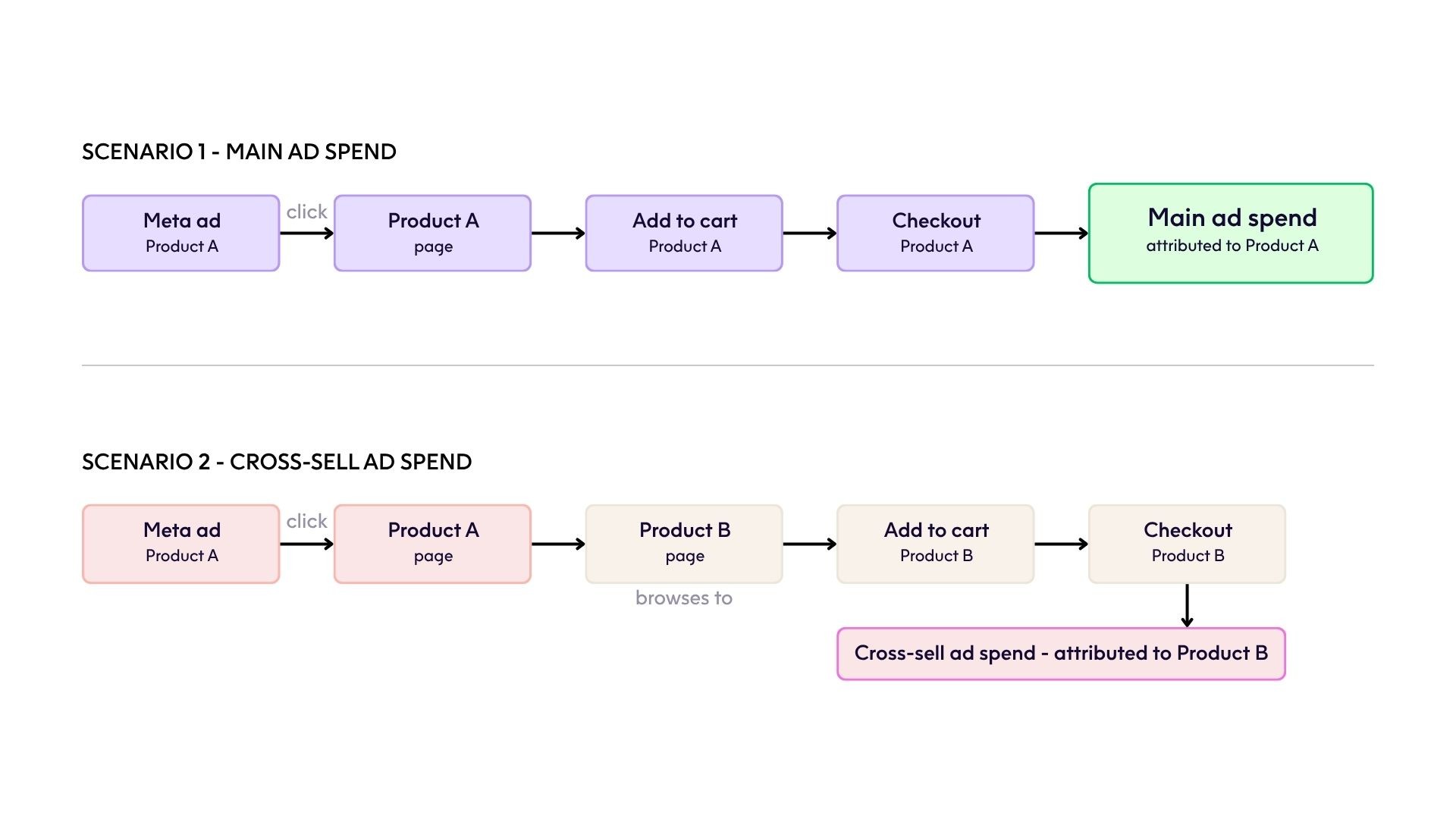
Cross-sell ad spend
Spend attributed to a different product's ad, but this product was purchased alongside it. The demand came from elsewhere — this product was a passenger in the transaction.
Note: Main + cross-sell won't add back to total. The remainder includes spend from collection pages, brand campaigns, and upper-funnel activity that contributed to the sale but isn't tied to a specific product ad.
We can go further into the details here, like there are impression-level equivalents — main impression spend and cross-sell impression spend — which show you where awareness of a product is being generated directly vs. as a byproduct of another product's campaign.
Also, there are spend allocation metrics: direct product spend, indirect product spend, and conversion-attributed spend — which show you how ad costs are assigned to a product intentionally, as a byproduct of another campaign, or based on its role in driving a conversion. But for this blog, we will just focus on the main three.
THE QUESTION THIS UNLOCKS
Is this product a demand driver — or a demand beneficiary?
That distinction completely changes how you'd approach scaling, creative investment, and budget allocation.
HOW TO READ THE SIGNALS
High main spend + strong ROAS → SCALE 📈
This product is pulling its own weight. Creative and demand are working. Confidence to invest more directly.
High cross-sell, low main → INVESTIGATE 🔍
Demand exists but it's borrowed. Before scaling, test direct campaigns to validate whether this product can drive demand independently. If the lead product's ads stop, this one likely drops too.
High cross-sell impression spend → OPPORTUNITY 🙏
Your product is getting awareness as a byproduct of other campaigns — it's in the consideration set. Could be the right moment to convert that latent awareness with a direct campaign.
Low across all three → DIAGNOSE 🩺
Low visibility, low direct demand. The product may need creative investment — or it may naturally rely on other products to drive the journey.
WHY THIS MATTERS FOR SCALING DECISIONS
A product with high cross-sell ad spend might look efficient on ROAS — but the attribution is fragile. You're scaling on borrowed momentum. If the campaigns driving other products are paused or reduced, this product's performance will follow.
That's not necessarily a reason to avoid it. But it should change how confidently you scale, and it should prompt you to stress-test whether the product converts when it's the featured product in a campaign.
The best-performing products tend to show strong numbers in both main and cross-sell. They drive demand and benefit from other campaigns simultaneously. That's the signal you're looking for.
YOUR COMPETITORS ARE ALREADY USING THIS
The gap is widening.
While you're optimising off a single spend number, the best-performing DTC brands are making budget decisions at a level of product intelligence most teams don't even know exists.
They know which products are earning their spend and which are just along for the ride. They're doubling down on real demand drivers and pulling back on products that look efficient but aren't. That precision compounds — better allocation this month means more data, better creative decisions next month, and a growing ROAS gap between them and the competition.
Every week you're working from blunt spend numbers, you're making scaling decisions your competitors made more accurately. That's budget misallocated, creative investment wasted, and growth left on the table.
The brands seeing the biggest efficiency gains right now aren't spending more — they're spending smarter, on products they can prove deserve the budget.
FROM INSIGHT TO ACTION — AUTOMATICALLY
Knowing which products are demand drivers vs. demand beneficiaries is only useful if it changes what your ads actually do. That's where ProfitPeak's Dynamic Metafield tool comes in.
ProfitPeak writes your spend signals — main, cross-sell, ROAS, and more — directly into Shopify's metafields. Those metafields connect straight to the feed tools that power your Meta, Google, and TikTok ads. Set it up once, and your feeds automatically reflect your latest product intelligence.
How it works:
1. ProfitPeak calculates product-level spend signals in real time
2. Signals are written to Shopify metafields automatically
3. Your ad feed tools pick them up and act on them
4. Your campaigns optimise on better data — without a spreadsheet in sight
The result: your ad platforms are always working from the most accurate product-level picture, and your team isn't spending time manually pushing data between tools.
READY TO SEE IT IN ACTION?
Stop guessing which products deserve your ad budget.
See how ProfitPeak surfaces spend signals and puts them to work directly in your ad feeds — in a 30-minute demo.
Book a demo at profitpeak.io/demo
Carla Penn-Kahn
CEO & Co-Founder
Carla spent over a decade building and successfully exiting several e-commerce brands, following an earlier career in corporate advisory and investment at Credit Suisse.