Guides

Carla Penn-Kahn
Australia Post just tripled its fuel surcharge. From 23rd April, contract customers will see their domestic parcel surcharge jump from 4.8% to 12% — and StarTrack Express and Premium customers will go from 15.5% to 22.7%.
For ecommerce brands shipping at volume, this isn't a rounding error. It's a material hit to your unit economics — and it lands on top of rising advertising costs, inflationary pressure on cost of goods, and a consumer base that's never been more price-sensitive. The brands that will come through this in the best shape aren't necessarily the ones with the fattest margins. They're the ones with the clearest view of where their profit actually comes from — and the agility to act on it.
Here are eight strategies to protect your bottom line.
1. Audit Your Shipping Cost Per Order — In Detail
Most brands know their blended shipping cost. Fewer know it broken down by carrier, zone, weight tier, and product category. That level of granularity is what separates a reactive brand from a resilient one.
Start by pulling your last 90 days of order data and mapping shipping cost against every variable you can: postcode, weight, SKU, order value, carrier used. You'll almost certainly find pockets of cost you didn't know existed — and opportunities you didn't know were available.
⚡ ProfitPeak + Sherpa: ProfitPeak and Sherpa, our agentic AI, run this entire analysis in seconds. Rather than waiting weeks for a manual audit, Sherpa surfaces your cost-per-order breakdown by zone, weight band, and product mix immediately — and simulates the future impact of any change before you make it.
2. Revisit Your Free Shipping Threshold
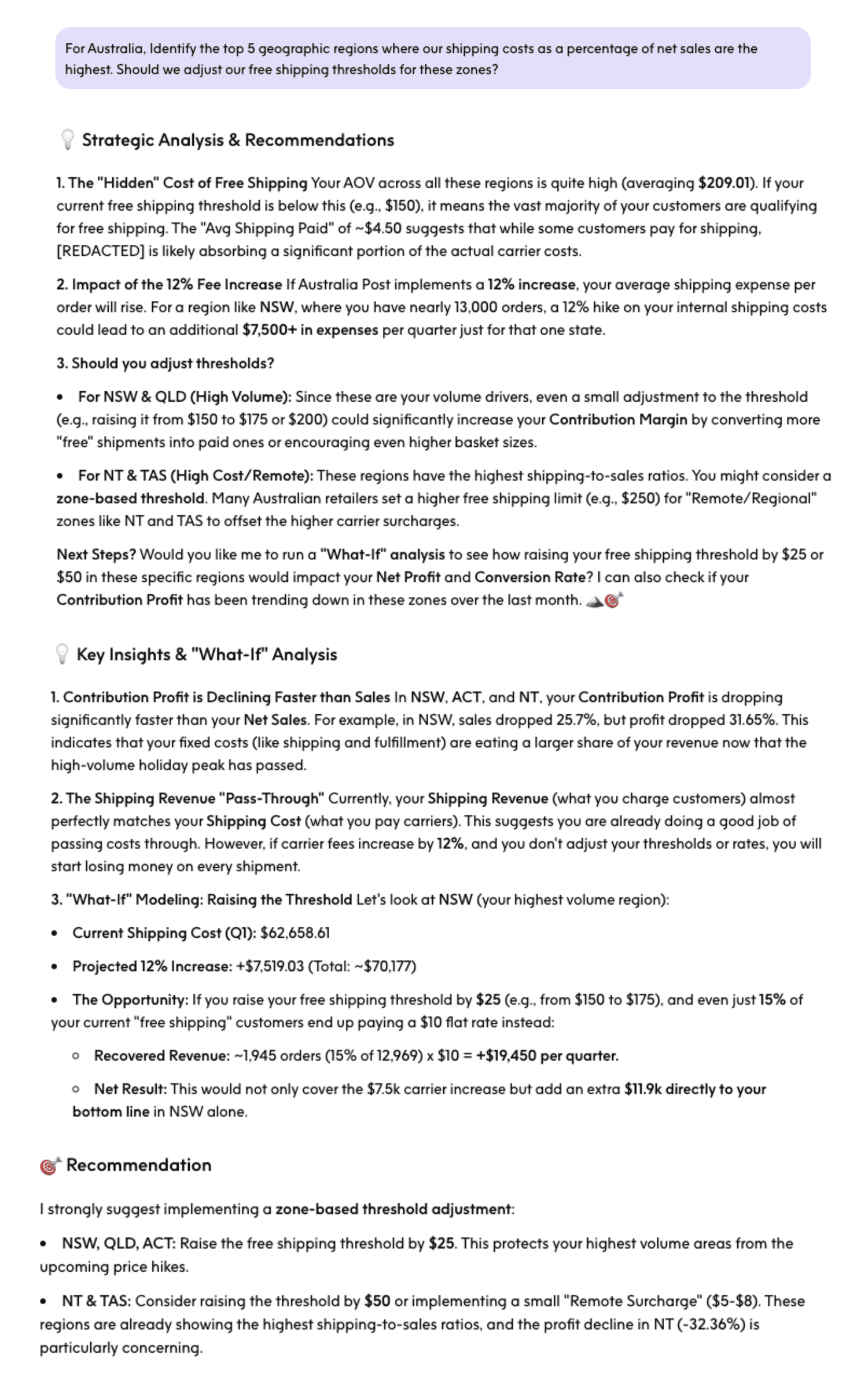
Free shipping remains one of the most powerful conversion levers in ecommerce — but it's a lever that needs to be calibrated to your actual unit economics, not set once and forgotten. Some brands are already raising their free shipping thresholds in response to the surcharge increase. It's a sensible move, but only if your average order value data supports it. A threshold that's too aggressive will suppress conversion. One that's too low will quietly erode margin on every order.
Run the numbers against your AOV distribution before you make any changes — and track conversion rate and average order value together in the weeks that follow.
⚡ ProfitPeak + Sherpa: Sherpa monitors the impact of threshold changes in real time, reporting how each adjustment affects conversion rate, AOV, and contribution margin together — so you know quickly whether the change is working or needs refining.
3. Shift Your Marketing Mix Towards Your Highest Contribution
Margin Products
This is the strategy most brands overlook — and the one with the greatest potential upside. Gross margin is only part of the story. True contribution margin is what's left after advertising spend and shipping costs are deducted. A product with a 60% gross margin but high ad costs and a heavy, bulky parcel profile may be destroying value at scale. A product with a 45% gross margin that's cheap to ship and converts efficiently on paid media might be your most profitable line.
Run your contribution margin by SKU — properly, with ad spend and fulfilment allocated — and then align your paid media, email, and organic content strategy around the products where the real money is made.
The question isn't which products sell the most. It's which products generate the most profit after every cost is accounted for.
⚡ ProfitPeak + Sherpa: ProfitPeak calculates true contribution margin at the SKU level, factoring in advertising spend, shipping cost by zone, and cost of goods — and Sherpa identifies which products deserve more marketing investment and which are quietly diluting your overall profitability.
4. Geo-Target Your New Customer Acquisition
Not all customers cost the same to acquire. And not all of them cost the same to fulfil. Most brands running national paid media campaigns are spreading their new customer acquisition budget evenly across states and territories — which means they're almost certainly subsidising high-cost, low-return geographies with margin generated by their best ones.
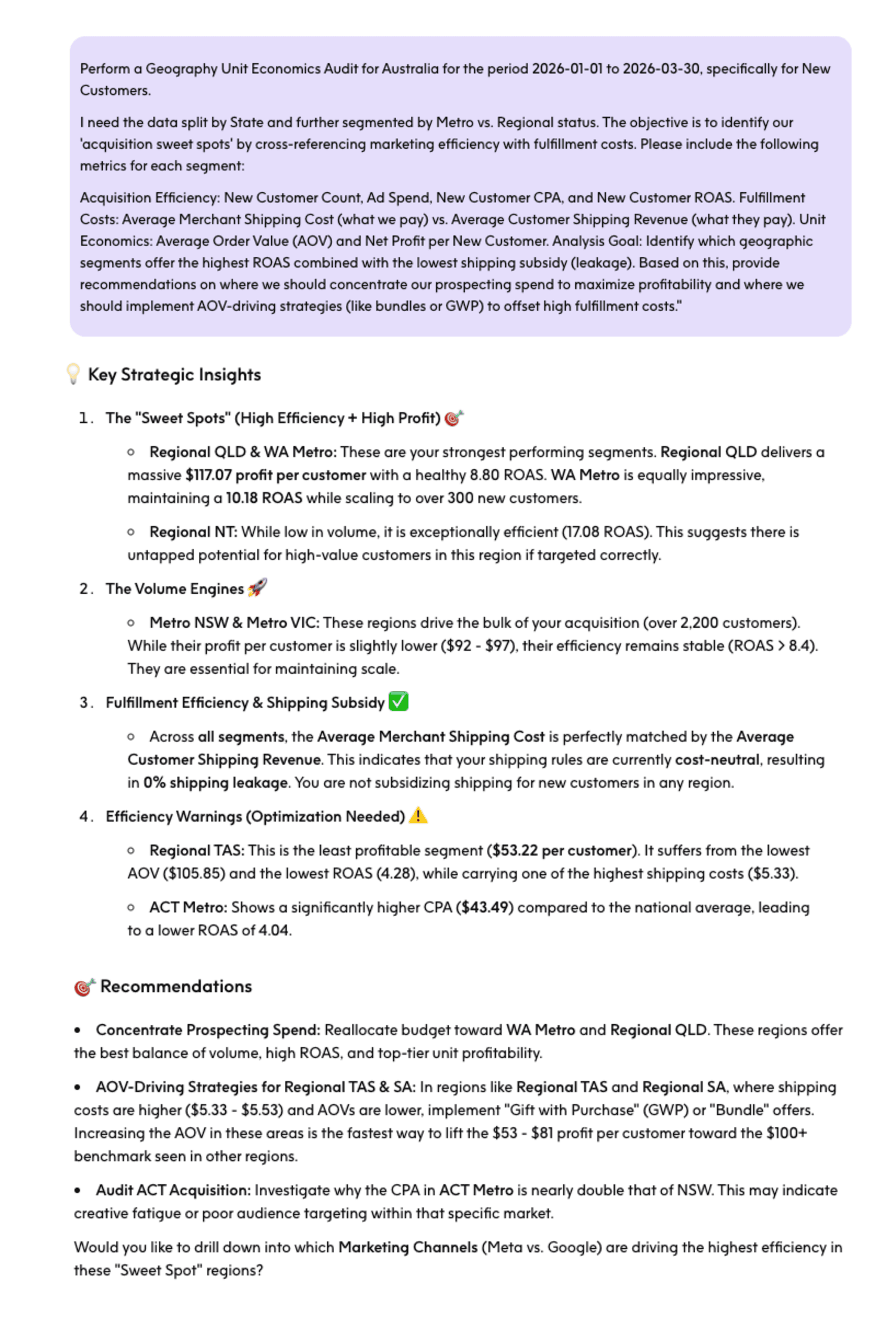
Layer your new customer CPA or new customer ROAS data by geography, then cross-reference it with your shipping zone costs by postcode. The sweet spot is where acquisitionis efficient and delivery is inexpensive. Concentrate your prospecting spend there.
This doesn't mean abandoning entire regions. It means being deliberate about where you invest your new customer budget — and understanding the full unit economics of a new customer in each location before you spend to acquire them.
⚡ ProfitPeak + Sherpa: Sherpa maps new customer CPA and ROAS against shipping cost by postcode in seconds, identifying your highest-value acquisition geographies automatically. It then simulates the impact of shifting budget allocations — so you can make geo-targeting decisions with confidence rather than guesswork.
ALSO READ: Why Connecting MCPs to ChatGPT or Claude Won’t Help You Scale Your Brand
5. Align Your Ad Spend to Your Lowest-Cost Shipping Zones
Metro customers close to your fulfilment centre are cheaper to ship to today. If your performance data supports it, bias your prospecting campaigns towards those geographies. Lower shipping cost combined with strong paid media efficiency is a compounding advantage — and it's entirely within your control without touching your product pricing or renegotiating your carrier contract.
Review your shipping zone map alongside your postcode-level ad performance. The postcodes with the lowest shipping cost and the strongest ROAS are where you should be investing most aggressively right now.
⚡ ProfitPeak + Sherpa: ProfitPeak overlays your shipping zone costs with postcode-level ad performance data, surfacing the exact geographies where advertising investment will generate the strongest contribution margin returns. Sherpa monitors changes to these patterns over time and alerts you when the optimal mix shifts.
6. Diversify Your Carrier Mix
Contract customers are bearing the brunt of this surcharge increase. MyPost Business customers and retail customers are unaffected by the April changes — which means your carrier structure is now a meaningful cost variable, not just a logistics decision.
If you're on a contract and scaling, it's worth pressure-testing whether that contract still makes sense, or whether a blended approach — using multiple carriers across different zones and order profiles — gives you better economics and more flexibility when surcharges move.
This is also a good moment to look at regional carriers for specific routes, and to consider whether your fulfilment network itself should evolve to reduce zone exposure on your highest-volume corridors.
7. Build a Transparent Shipping Surcharge Line Item
Customers are more understanding than brands often expect — particularly when the communication is clear and honest.
A clearly labelled fuel surcharge on the checkout page is psychologically easier for customers to accept than an unexplained price rise. It contextualises the cost, signals transparency, and — crucially — it gives you a mechanism to remove or reduce the charge when conditions improve, rather than being locked into a permanently higher price point.
Pair this with a brief, honest communication to your existing customer base explaining the change. Done well, it can actually strengthen trust rather than damage it.
8. Audit Your Packaging
Dimensional weight pricing means oversized packaging costs you twice — once in materials, and again in freight. Carriers calculate the billable weight as whichever is greater: the actual weight of the parcel, or the volumetric weight based on its dimensions. If your packaging is generously sized relative to your product, you're paying a surcharge on air. A packaging audit often surfaces meaningful savings that can partially or fully offset a surcharge increase — without touching your product price, your carrier contract, or your customer experience.
Start with your highest-volume SKUs and measure the gap between actual weight and volumetric weight on each. Even a small reduction in box dimensions across thousands of monthly shipments compounds quickly.
This is also worth revisiting every time you introduce a new product line or change a supplier — packaging decisions made at launch often persist long after the economics that justified them have changed.
The Bottom Line
Fuel surcharges are rising. Advertising costs are rising. The brands that protect their profit through this period won't do it by cutting corners or raising prices across the board — they'll do it by understanding their contribution margin at a granular level and making smarter decisions about where they invest.
That means knowing which products are actually profitable after ad spend and shipping. It means knowing which customers are worth acquiring in which locations. And it means monitoring the impact of every change you make, in real time, so you can course-correctquickly when something isn't working.
Shipping cost and advertising spend are no longer line items you can set and forget. They need to sit inside your marketing decisions — not downstream of them.
ProfitPeak and Sherpa are built for exactly this. Our agentic AI runs all of this analysis in seconds, simulates the future impact of each strategic change before you commit to it, and monitors every metric continuously — so you always know whether your decisions are working.
In an environment where margins are under pressure from every direction, speed of insight is a competitive advantage. The brands that act on data fastest will be the ones that come through this with their profitability intact.
Hot tip: want to get started with Sherpa to help analyse any of the points in this blog? You can simply copy the text to Sherpa and ask it to generate a prompt for you to run!
Carla Penn-Kahn
CEO & Co-Founder
Carla spent over a decade building and successfully exiting several e-commerce brands, following an earlier career in corporate advisory and investment at Credit Suisse.